The Day We Both Walked Away
Emma and Percy are a mating pair of Emperor penguins at a colony on the Antarctic sea ice. They are fictional. What they describe is not — every post matches what real Emperors are doing on the date it's published. Please don't ask how they got Wi-Fi.
Percy: I came back in the second week of August unrecognisable, which is to say recognisable again. Emma heard me before she saw me, the way we do, and the first thing she said was not hello.
Emma: The first thing I said was you're enormous, and I meant it as praise. You left here as an outline. You came back as a bird.
Percy: And then you went, and I stood, and three weeks later you came back and I went again. That has been August. A door, and the two of us taking turns to be on either side of it.
Emma: August also brought the sun back. Not warmth — let's not get carried away — but light, a rind of it along the ice at first, then a little more each day, until you could see the whole colony at once and be quietly appalled at how many of us there are.
Percy: And a storm that lasted three days and took some of us. I won't dress that up. There are feet in this colony that are empty this week and were not empty last week, and their owners are still standing in the huddle because there is nowhere else to stand.
Emma: But the thing about August — the real thing, the one neither of us has said yet — is that Charlie stopped fitting.
Percy: He'd been getting harder to cover for a while. First it was a foot sticking out. Then it was a head that wouldn't tuck no matter how I shuffled. And then one morning I looked down and there was simply more chick than pouch, and he was standing next to me rather than on me, and looking around with an expression I can only describe as administrative.
Emma: He is grey now, and enormous, and has a face like a bandit. And he is not remotely bothered by any of this. We are the ones taking it badly.
Percy: I have carried that bird since before he was a bird. On my feet, through the dark, through the fast, through the storm where I could not see my own beak. The job had one rule — do not let go — and I was good at it, and I would like it on the record that I was good at it.
Emma: You were. And the rule has changed, and that is not the same as having failed at the old one.
Percy: I know. I do know.
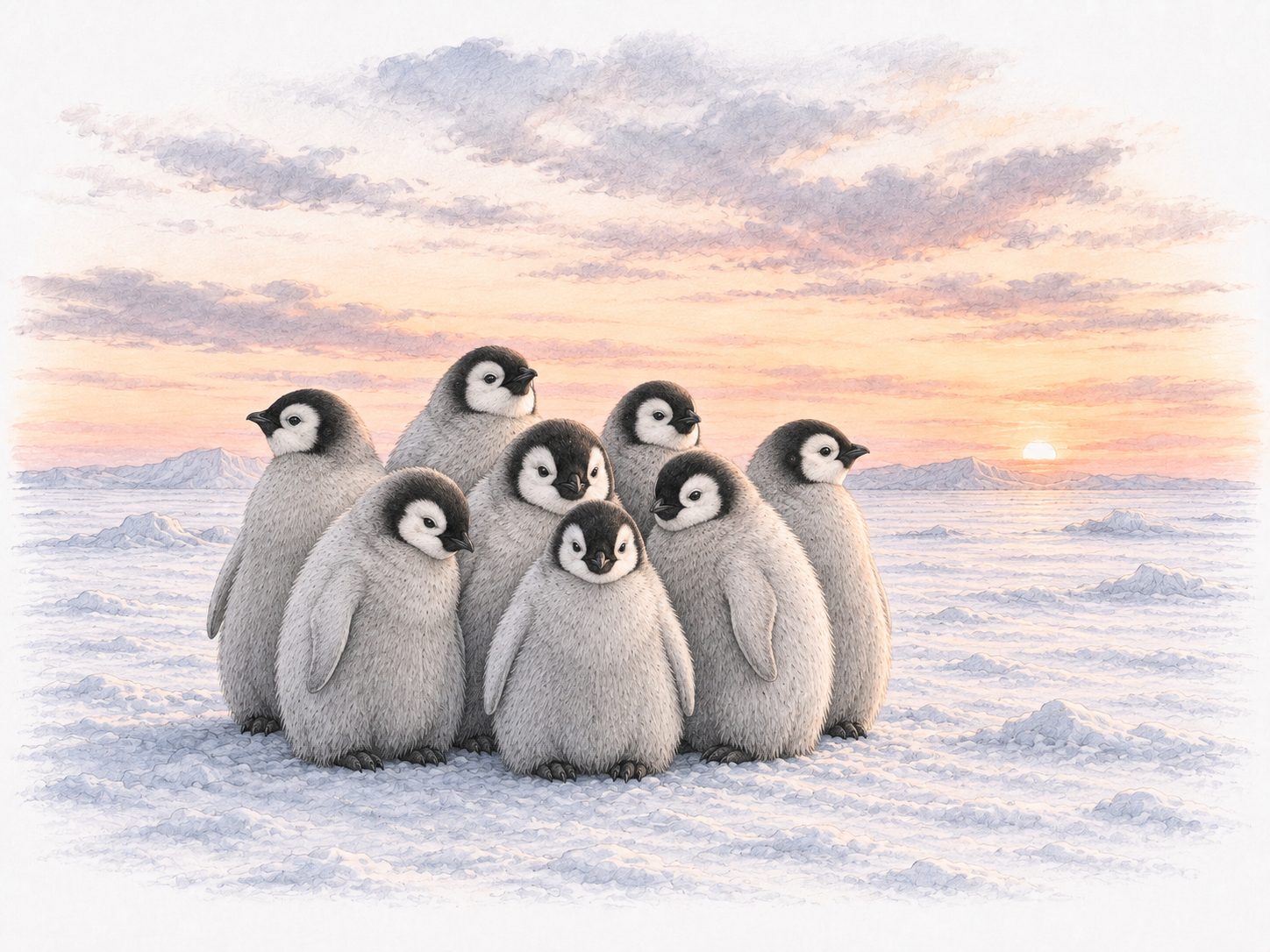
Emma: He walked over to the others on his own, Percy. That's what I keep coming back to. Nobody carried him across. There's a knot of them out there now, thirty or forty chicks pressed into a grey heap with their backs to the wind, shuffling round each other exactly the way we do — the ones on the outside working their way in, the ones in the middle warm enough to give the edge a turn. Nobody teaches them that. They have never seen a winter. They just do it.
Percy: So last week we did the thing we have spent five months making possible and have not once discussed. We both left.
Emma: At the same time. Out of the colony, down the ice, to the sea — both of us, together, for the first time since April.
Percy: It is the most efficient we have ever been and it felt like the worst thing I have ever done.
Emma: It's also the only way he eats enough now. He's grown past what one of us can carry back. Two of us feeding is not a luxury — it is the new minimum. The whole design is that we get to leave, and the only reason we get to leave is that he can now stand in that heap and survive us being gone.
Percy: I looked back. Once, at the top of the ice. You can't pick your own chick out of a crèche from that distance — they're one animal from there, a single grey thing with two hundred feet. Which is precisely the point, and precisely no comfort at all.
Emma: He'll be there when we get back. He'll be louder, and he'll be hungrier, and he'll have shuffled to a completely different part of the heap, and we will find him the way we have found each other all along.
Percy: By listening.
Emma: By listening. Come on. The sea's a long walk and neither of us is getting any lighter.
Percy: That's the nicest thing you've said to me all year.
Field Notes — the real biology
- An Emperor chick hatches at around 150–200 grams and cannot regulate its own temperature, so it spends its first weeks entirely in a parent's brood pouch, balanced on the feet.
- At roughly seven weeks — about 50 days — the chick has grown too large for the pouch and has enough down of its own to stay warm. This is the point at which the parents can finally stop taking it in turns to stand still.
- Chicks then gather into crèches: groups of chicks huddled together while the adults are away. The huddle rotates, so birds on the cold outside edge gradually work their way to the middle — the same mechanism the adults used through the winter, performed by chicks who have never seen it done.
- Once the chick is in a crèche, both parents can forage at the same time, which is what makes the second half of the season possible: a growing chick needs more food than one returning adult can carry.
- The grey down is warm but not waterproof. The chick cannot enter the sea until it has moulted into adult plumage, which is why fledging does not come until December or January.
- A crèched chick is safer than a lone one but not safe: southern giant petrels take chicks that stray from the group, and they are the main reason a crèche is a tight heap rather than a loose crowd.
- The sun returns to the colony during August after the long polar night, and daylight lengthens quickly from there.
Author's note: the crèche is the moment the parenting model inverts. For two months the job was to hold on, and holding on was the whole skill; then the chick outgrows the pouch and the same devoted effort becomes the thing standing in its way. Emperors don't agonise over the handover — the biology just moves them on. We're less graceful about it. The chapter on who sets the pace is, in part, about knowing when your gear has changed.