The First Time We Were Three
Emma and Percy are a mating pair of Emperor penguins at a colony on the Antarctic sea ice. They are fictional. What they describe is not — every post matches what real Emperors are doing on the date it's published. Please don't ask how they got Wi-Fi.
Emma: I found you the way I always find you — not by looking. There are ten thousand birds between the ice edge and the huddle and every one of them is the same shape as you, and none of them is you, and the difference is a sound. I called once. You answered once. That was the whole map.
Emma: And then there was a second voice. Smaller. New. Answering out of the fold of your belly before I'd even reached you, in a call I have somehow never heard and knew immediately, the way you know your own name in a language you don't speak.
Percy: She walked in out of the wind and I forgot, for a moment, how tired I was. That's the honest version. Ten days I've stood here doing the one job, telling myself I could keep doing it another ten if I had to — and then you were there, full and gleaming and impossibly heavy with the sea, and the arithmetic of it all just stopped mattering.
Emma: Percy, you've lost half of yourself. I can see it. You stand differently. Don't argue — I've done this crossing on a full stomach and you've done a winter on none, and I know exactly which of us gets to be tired out loud.
Emma: So here's the first thing, before anything else. Charlie's fed. Properly, this time — not the last of what you could spare, but fish, real fish, the kind that was still in the sea this week. I have carried it across a hundred kilometres of ice inside me for precisely this, and watching it go from me to that small insistent mouth was worth every step of the walk I complained about the entire way.
Percy: The handover is the frightening part, and nobody tells you that either. Getting a chick from my feet to yours is the same trick as the egg was, back at the start — except the egg only had to survive the cold, and Charlie can undo it by wriggling. Two minutes of open air is all it would take. So we did it slowly. Belly to belly, no daylight between us, the way we practised on a thing that couldn't complain.
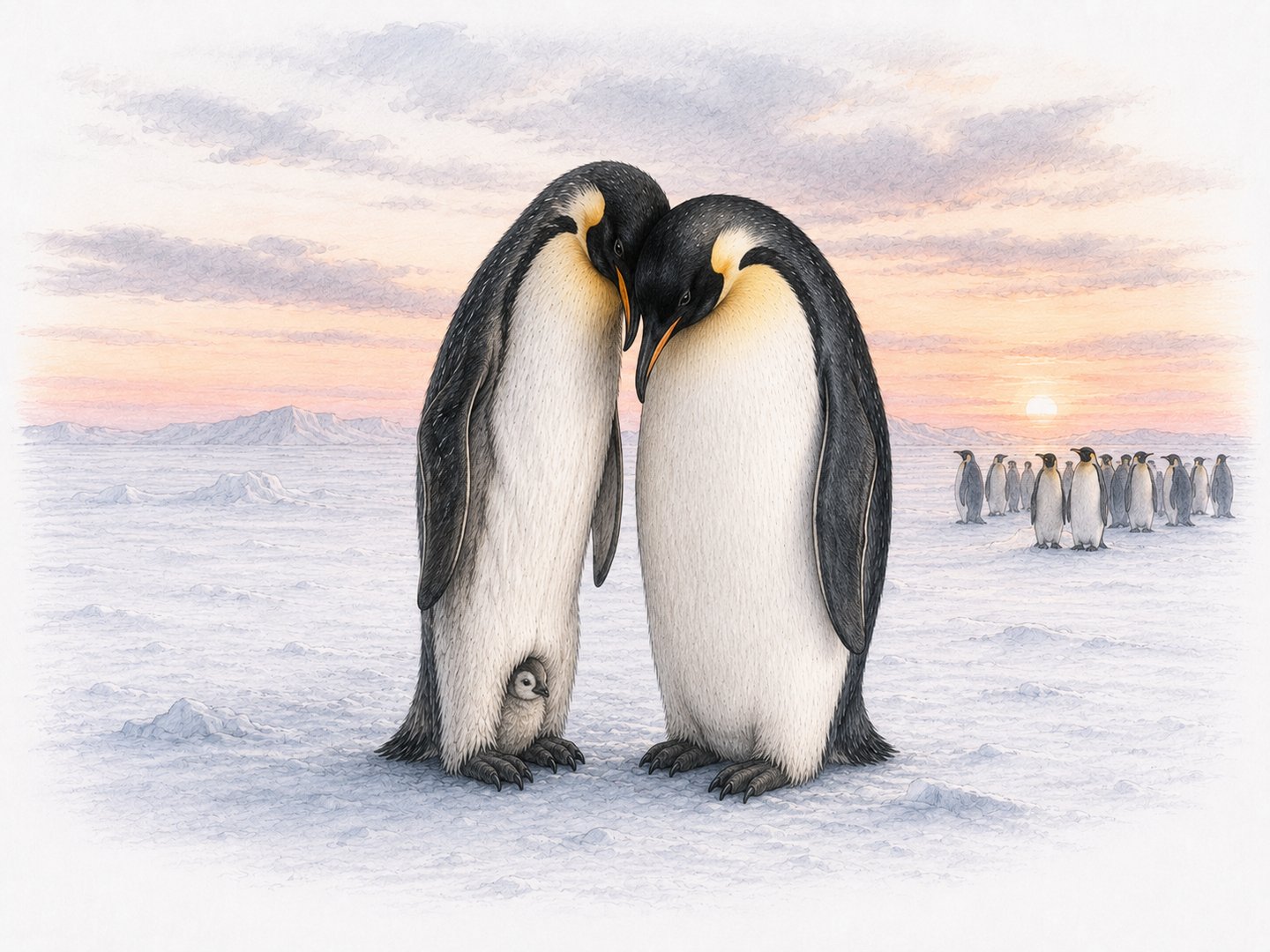
Emma: And now he's mine to keep warm, and yours to leave. I know what I'm asking. You've held this colony's entire future on the tops of your feet since May, and the reward for doing it perfectly is that you now have to walk away from it and trust me with the only thing you've ever guarded.
Percy: I do trust you with it. That was never the hard part. The hard part is that the sea is a long way off and I am not the bird I was when I last saw it. But that's the design. One of us stands, one of us feeds, and we take it in turns until this small loud person can stand and feed itself. My turn to stand is over. Yours has just begun.
Emma: Go. Eat something that isn't your own body. Come back to us fat and unbearable and full of the sea, and I'll pretend to complain about it. Charlie and I will be exactly here — that's the whole point of here.
Percy: Look after our knock.
Emma: He's not a knock any more, Percy. He's a voice. And I already know it anywhere.
Field Notes — the real biology
- The returning female locates her mate and chick in a colony of thousands using vocal recognition alone — a two-part call that both birds learned before the chick even hatched. No landmarks, no memory of position on shifting ice; just sound.
- She arrives having refed at sea, carrying fish and krill in her stomach, and delivers the chick's first full meal by regurgitation — the handover of feeding duty from father to mother.
- Transferring the chick between parents' brood pouches is as delicate as the original egg transfer: a newly hatched chick cannot regulate its own temperature and can die within a couple of minutes if exposed on the open ice, so the pass is done belly-to-belly, fast.
- By the time the female takes over, the male has fasted for roughly 115 days and lost 40–50% of his body mass. Only now does he make the long walk back to open water to feed for the first time since arriving at the colony.
- From this point the parents alternate: one broods and feeds at the colony while the other forages at sea, swapping every week or two, all the way through to the chick fledging around December–January.
Author's note: the late-July, early-August window is exactly when returning females rejoin newly hatched chicks and relieve the fasting males. Emma's walk back, her stomach full of the sea, and Percy's departure aren't sentiment — they're the calendar. This is the moment the labour finally splits back in two.