The Last Stretch
Emma and Percy are a mating pair of Emperor penguins at a colony on the Antarctic sea ice. They are fictional. What they describe is not — every post matches what real Emperors are doing on the date it's published. Please don't ask how they got Wi-Fi.
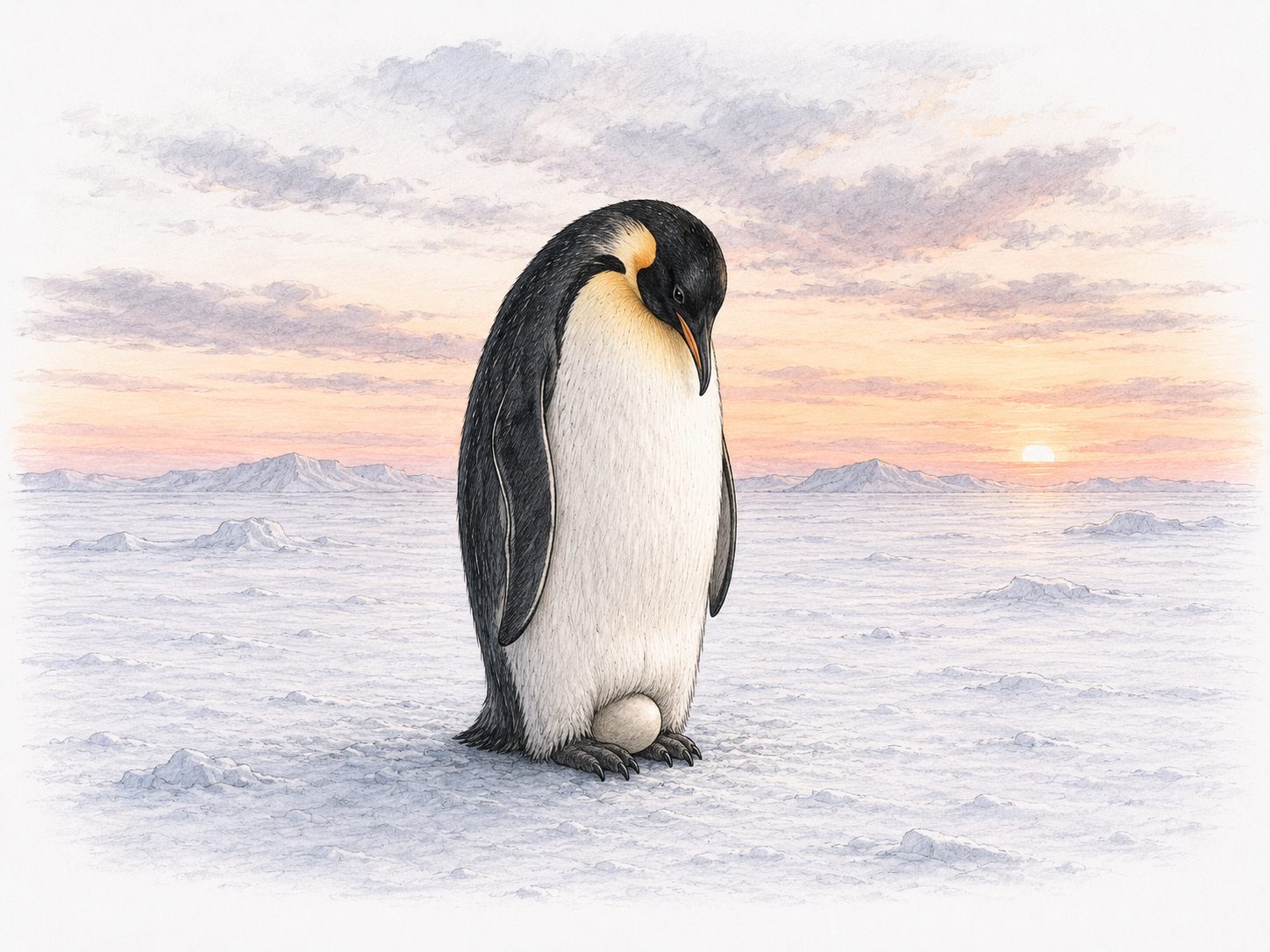
Percy: Week six. I've stopped describing the cold, because at this point it isn't weather, it's just the room I live in. What I will describe is the sound. Last night, for the first time, I heard something that wasn't wind, wasn't a neighbour, wasn't me. It came from under my feet.
Emma: Say it properly.
Percy: The egg is making noise. Not much. A small, private, muffled sound, like someone humming with their mouth shut in the next room. I have been informed — by the sort of bird here who reads too much — that this is normal. Apparently they start finding their voice before they've found daylight. Getting a head start on recognising the two idiots who are meant to be its parents.
Emma: We are not idiots.
Percy: We are, mildly, but affectionately. Anyway. It talks now. I talk back, quietly, because apparently that matters too — it's meant to be learning what I sound like before it ever opens an eye.
Emma: How are you holding up, actually. Not the performance. The real number.
Percy: Thinner than I've ever been and getting thinner. I won't pretend the last stretch is the same as the first. Early on this was uncomfortable. Now it is closer to the edge of what I can do and still stand upright in a wind. I am rationing effort the way I used to ration nothing, because there was never a need to.
Emma: That's not a complaint I like hearing.
Percy: It isn't a complaint. It's a status report. There's a difference, and you taught me the difference, so credit where it's due.
Emma: I'm packed. Genuinely — I have eaten like the last two months were a personal grudge match against an entire ocean of krill. When I come back I am not arriving light. I am arriving as a delivery.
Percy: Good. Because the maths only works one way from here: either you get back with the delivery before I run out of road, or I find out exactly how far "further than I thought" actually goes. I'd rather not find out.
Emma: You won't have to. I'm closing the distance. Not days yet — but it's weeks now, not months, and every one of them is shorter than the last.
Percy: Weeks. After everything, it still comes down to weeks. Hold that thought for me — I'm going back to listening to the small noise under my feet.
Emma: Tell it its mother says hello.
Percy: I'm not saying that out loud to an egg.
Emma: Tell it anyway.
Field Notes — the real biology
- Emperor chicks begin making faint vocalisations from inside the egg in the final stretch before hatching — the start of the individual vocal recognition that later lets a parent find one chick in a creche of thousands, purely by call.
- By this stage of the fast, incubating males have lost up to 45% of their pre-breeding body mass, and energy expenditure is managed by huddling and near-total stillness — there is very little reserve capacity left this late in the season.
- Total incubation runs 62–67 days; a chick laid in late May is due to pip in the second half of July, meaning the male is now inside the final quarter of the fast.
- Females time their return to coincide with hatching, arriving with a stomach full of food gathered over the preceding weeks at sea, specifically to feed the chick within hours of arrival.
- If the female is delayed past hatching, the male can produce a small quantity of a curd-like secretion from his oesophagus to keep the chick alive briefly — an emergency measure, not a substitute for the female's return.