Four Weeks In, and the Sun Still Owes Us
Emma and Percy are a mating pair of Emperor penguins at a colony on the Antarctic sea ice. They are fictional. What they describe is not — every post matches what real Emperors are doing on the date it's published. Please don't ask how they got Wi-Fi.
Percy: Week four on the egg. It is the dead middle of winter, the sun is a rumour, and I have not eaten since autumn. People keep waiting for the dramatic instalment. This is the instalment. Nothing happens, magnificently, for two months.
Emma: I'm a hundred kilometres away at the ice edge, throat-deep in fish, and even I can feel him being noble about it.
Percy: I'm not being noble. I'm being still. There is a difference and the difference is roughly forty degrees below zero.
Emma: Tell them about the storm.
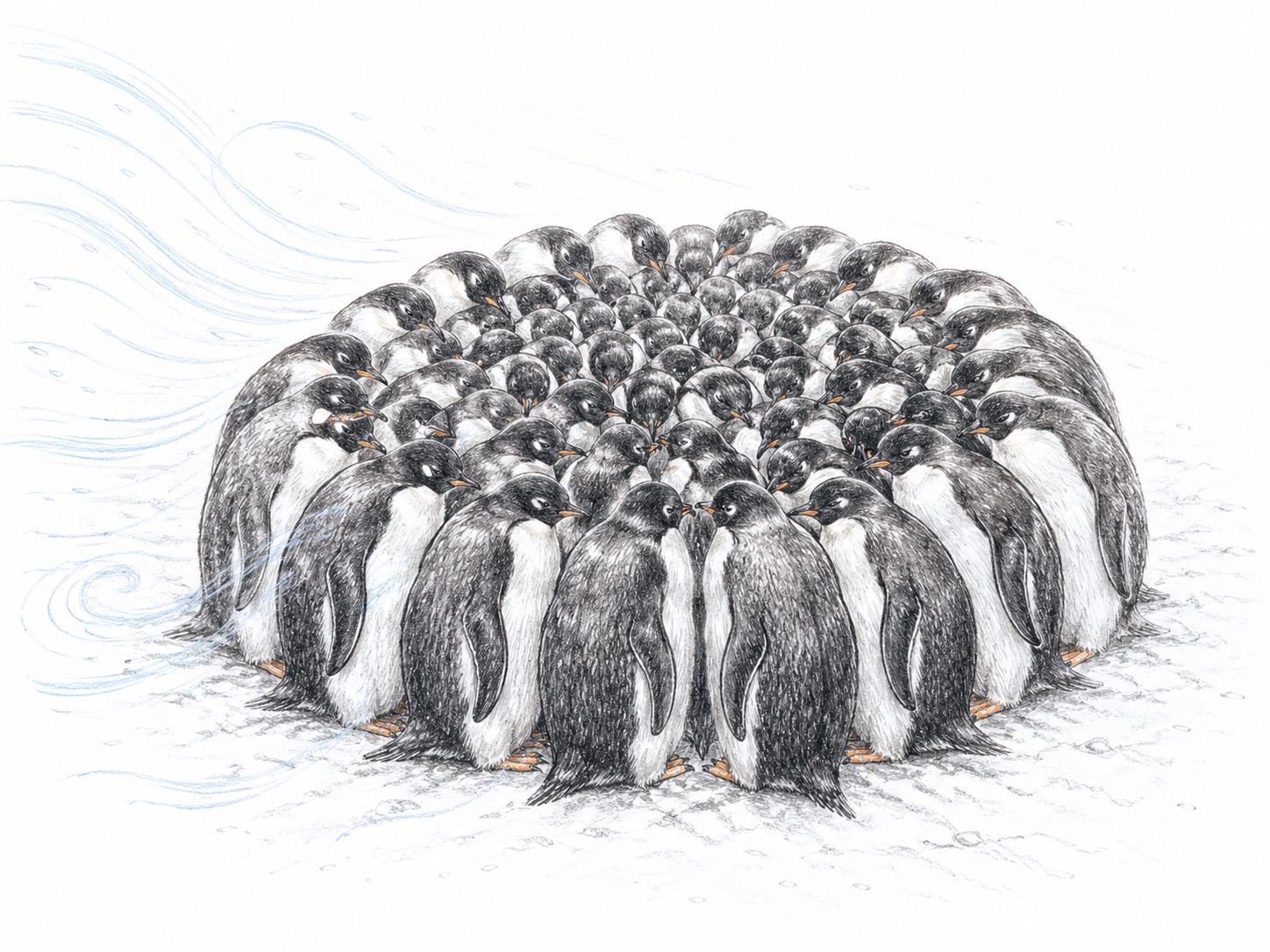
Percy: There was a storm. Three days of wind that comes at you sideways and takes the warmth out through your eyes. When it hits, the huddle stops being a loose social arrangement and becomes one organism — thousands of us pressed so tight you breathe in time with the bird in front. You shuffle a few centimetres a minute. The whole mass turns slowly, like something stirred in a pot, and that slow turn is the only reason any of us on the edge survive it.
Emma: And the egg.
Percy: Never left my feet. Four weeks now it's ridden up there under the flap at a steady thirty-six degrees while the world above it tried to drop to minus sixty. That's the one number that isn't allowed to move. Everything else about me can fail. Not that one.
Emma: He's lost about a third of himself already. I can hear it in how he writes. By the time I waddle back in August he'll be two-thirds the husband I left, which — careful, Percy —
Percy: I was going to say nothing.
Emma: — which is still more husband than most. Out here it's the opposite problem. I dive, I eat, I dodge the things that want to eat me, and I bank every gram of it. I am not coming home with a polite snack. I am coming home as the entire grocery run for a chick I haven't met.
Percy: Five weeks or so to go on the egg, if the books are right. Then either you're back, or I find out what my body does for an encore.
Emma: I'll be back. Keep him warm. Keep yourself attached to the planet during the next storm. I've grown fond of the arrangement.
Percy: "Fond." Write that down, everyone. She put it in writing.
Field Notes — the real biology
- Emperor incubation lasts 62–67 days through the heart of the Antarctic winter. The egg is balanced on the male's feet under the brood pouch and held near 36 °C, regardless of an outside air temperature that can fall to −60 °C.
- During the worst weather the huddle tightens dramatically: densities reach around 10 birds per square metre, and the packed centre can climb above +30 °C. The huddle continuously rotates so birds cycle from the freezing windward edge to the warm core — no leader, no signal, just thousands of small adjustments.
- A huddling male spends far less energy than one standing alone; huddling is what makes the ~115-day total fast survivable at all. Across it the male loses up to 45% of his body weight.
- The female feeds at sea (often 50–120 km away) for roughly two months, returning around hatching with a stomach full of food she will regurgitate as the chick's first meals.
- Polar night is real: at high-latitude colonies the sun stays below the horizon for weeks, so almost the entire incubation happens in darkness or deep twilight.