The Egg, the Handover, and the Long Dark
Emma and Percy are a mating pair of Emperor penguins at a colony on the Antarctic sea ice. They are fictional. What they describe is not — every post matches what real Emperors are doing on the date it's published. Please don't ask how they got Wi-Fi.
Emma: Three weeks ago I laid an egg roughly the size of a grapefruit and a tenth of my body weight, balanced it on my feet, and then did the single most stressful thing in an Emperor penguin's calendar: I gave it to my husband.
Percy: The handover went fine.
Emma: The handover took four attempts, and on attempt two you nearly rolled our entire genetic legacy onto the ice. An exposed egg freezes in about two minutes, Percy. Two minutes.
Percy: And yet here it is, snug on my feet, under my brood flap, at a steady 36 degrees. I'd call that a success. You shuffled off toward the sea looking back over your shoulder like I'd never incubated anything.
Emma: You hadn't ever incubated anything.
Percy: Everyone has a first egg.
Emma: So now we're doing this season the way Emperors do: completely backwards by everyone else's standards. I walked the best part of a hundred kilometres back to open water, and for the next two months my job is to eat. Squid, fish, krill — I am, in the most literal sense, eating for two, because everything I bring back in August is the baby's first meal. People call it a holiday. It is a work trip with leopard seals.
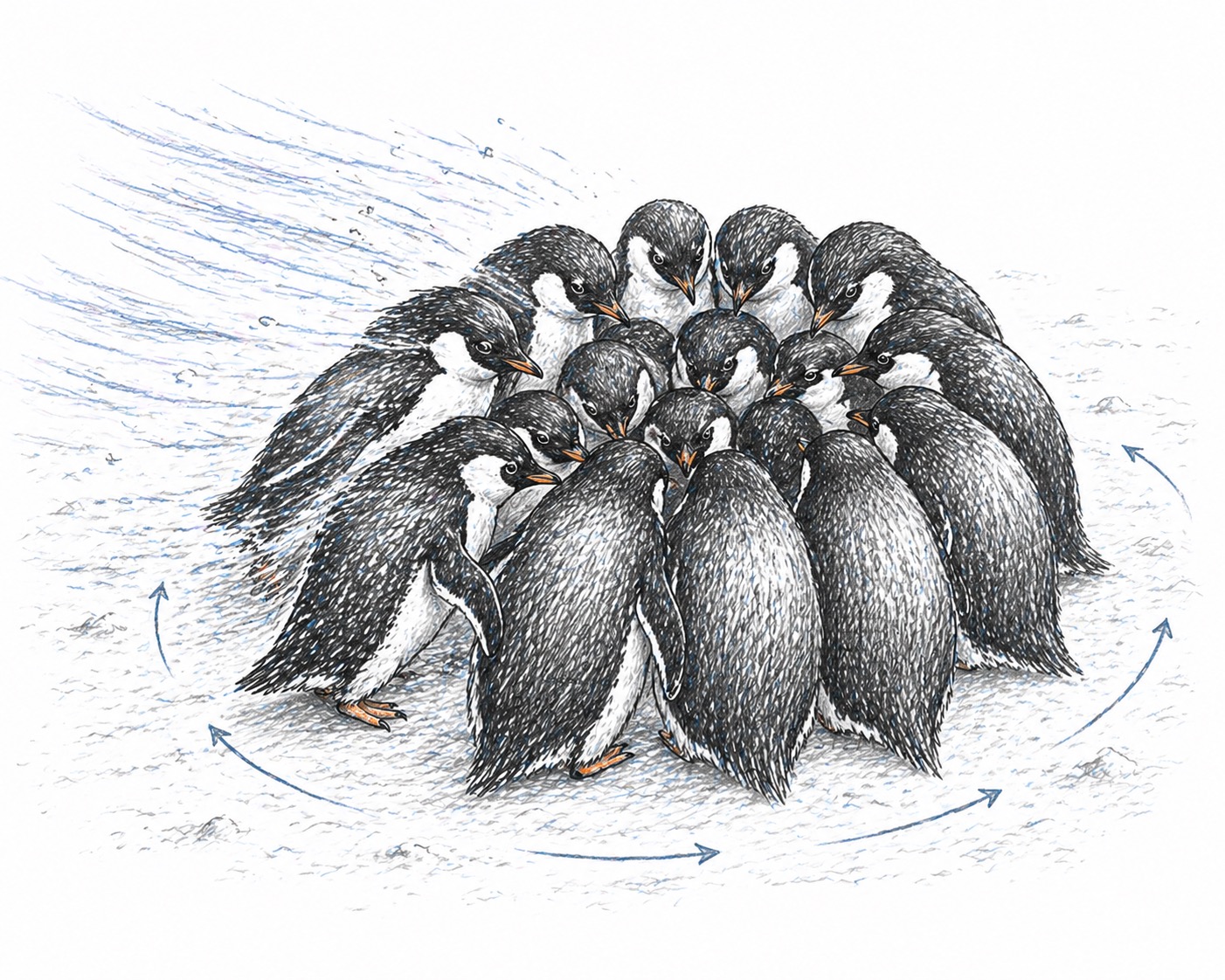
Percy: Meanwhile I'm holding the fort. By which I mean: standing still. For two months. In the dark. The sun went down in May and it isn't coming back until winter's done — and the colony has packed itself into a huddle several thousand strong. It's minus fifty out, the wind is doing something indecent, and the lads and I take turns on the windward edge. You do your shift on the outside, then the huddle shuffles and you drift to the warm middle. Nobody organises it. It just works. Everyone takes a turn in the wind so that nobody freezes.
Emma: He says "holding the fort" — he hasn't eaten since April and won't until I'm back. He'll lose close to half his body weight keeping our egg at incubation temperature through an Antarctic winter. I want that on the record, because I intend to bring it up never, and he'll bring it up constantly.
Percy: It's a bit fresh out, that's all. Egg's warm. That's the job.
Emma: Mid-August, Percy. I'll be the well-fed one calling your name across ten thousand identical dinner jackets. Try to have our child hatched and not embarrassing by then.
Percy: No promises on the second part. Takes after his mother.
Field Notes — the real biology
- Emperor penguins breed in the Antarctic winter — the only penguin to do so. A single egg of around 460 g is laid between May and early June. It's the only egg the pair will produce all year, so there is no spare.
- The egg transfer from female to male happens within hours of laying and is genuinely dangerous: on the ice, an exposed egg can die of cold in about two minutes. Inexperienced pairs do sometimes lose the egg at this step.
- The female then walks (and toboggans) up to 50–120 km to open water and feeds for about two months. The male incubates the egg on his feet under a fold of skin called the brood pouch for 62–67 days, through polar night, in temperatures down to −60 °C and winds over 150 km/h.
- By the time the female returns around hatching (late July–August), the male will have fasted around 115 days in total and lost up to 45% of his body weight. If the chick hatches before mum is back, dad feeds it a milky secretion from his oesophagus — single parenting, on an empty stomach.
- The huddle is real and genuinely leaderless: thousands of males continuously rotate so each takes a turn on the cold windward edge, and the centre can reach +30 °C.