One Egg, Two Minutes
Emma and Percy are a mating pair of Emperor penguins at a colony on the Antarctic sea ice. They are fictional. What they describe is not — every post matches what real Emperors are doing on the date it's published. Please don't ask how they got Wi-Fi.
Emma: It's here. One egg, about 460 grams, the only one we'll make all year. There is no spare. I want to write that twice so it lands: there is no spare.
Percy: It's beautiful.
Emma: It's cold-sensitive, is what it is. And now comes the part I've been dreading since the trumpet: I have to get it off my own feet and onto yours without setting it down on the ice. Because if it touches the ice, in this air, it's gone in about two minutes.
Percy: So we go slowly.
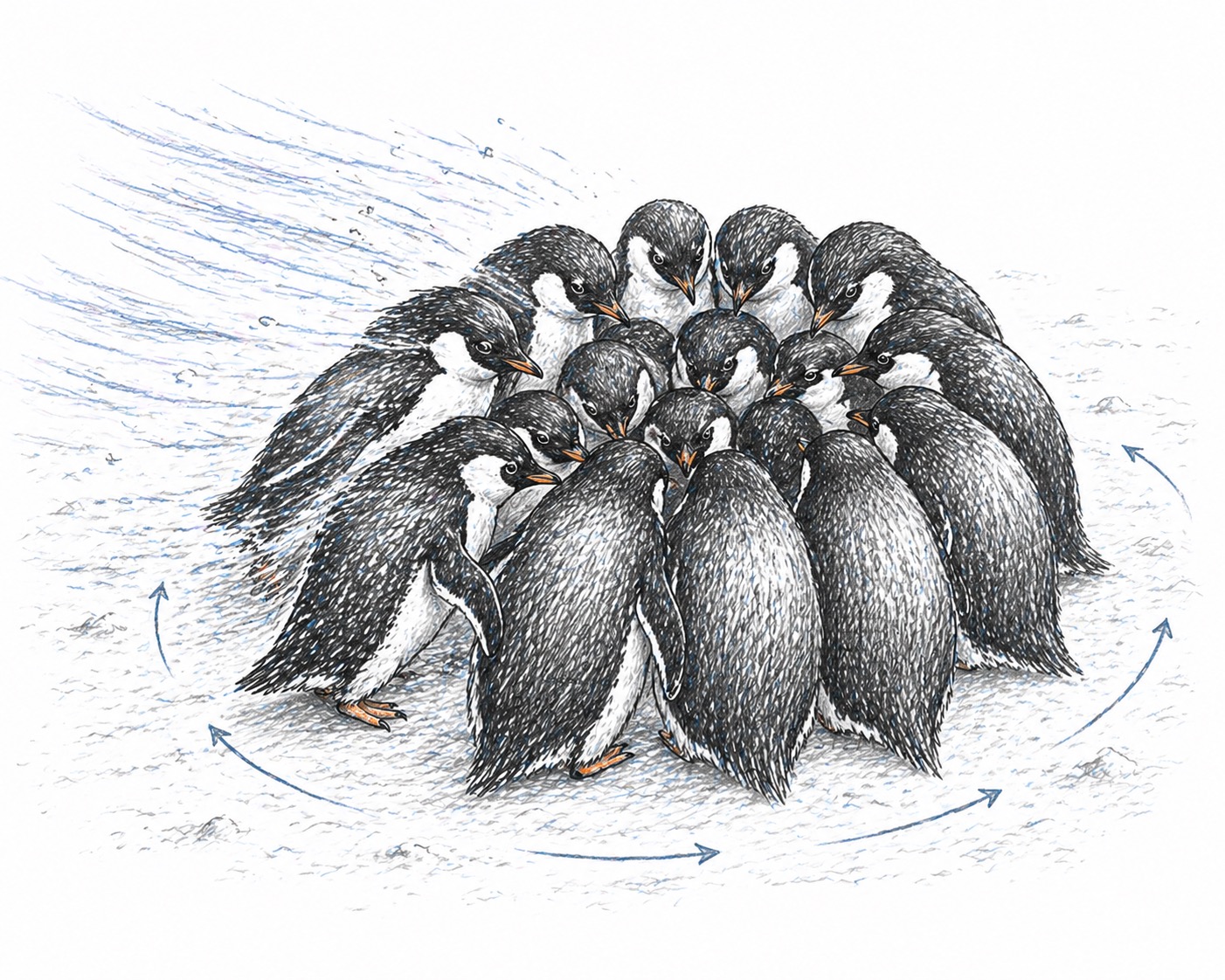
Emma: We go slowly. Beak-low, feet shuffling, the egg rolling the few centimetres from my brood flap to yours like it's the last egg on Earth — which, for us, it is. Don't talk. Don't rush. Don't be optimistic at me. Just take it.
Percy: ...Got it. It's on my feet. Under the flap. Warm.
Emma: Then that's me. I've not eaten properly in weeks and there's a hundred kilometres of ice between me and the next meal, so I'm going while my legs still believe in me. Keep it at thirty-six degrees. Keep it off the ice. I'll be back around the time it hatches with a stomach full of its first dinner.
Percy: Go on. We'll be here. Standing very still, getting very good at it.
Emma: I know you will. That's why I picked the one with the silly trumpet.
Field Notes — the real biology
- The female lays a single egg of around 460–470 g between May and early June — about 1.5% of her body weight, not a tenth, but still the only egg the pair will produce all year. There is no replacement if it's lost.
- The transfer from the female's feet to the male's happens within hours of laying and is genuinely dangerous: on the ice in winter air, an exposed egg can freeze in about two minutes, and inexperienced pairs do sometimes lose it at this step.
- The female then walks and toboggans 50–120 km back to open water to feed for around two months, while the male takes over incubation. By the time she returns near hatching, the male will have fasted for roughly 115 days in total.